DLM — Document Language Model
Turn a text file into a fine-tuned LLM. Edit the document, retrain, share.
A .dlm file is YAML frontmatter + markdown body with ::instruction:: and ::preference:: sections. Train a LoRA adapter on your document, prompt it, export to Ollama. This extension makes .dlm authoring a first-class editor experience.
Features
Syntax-aware editing
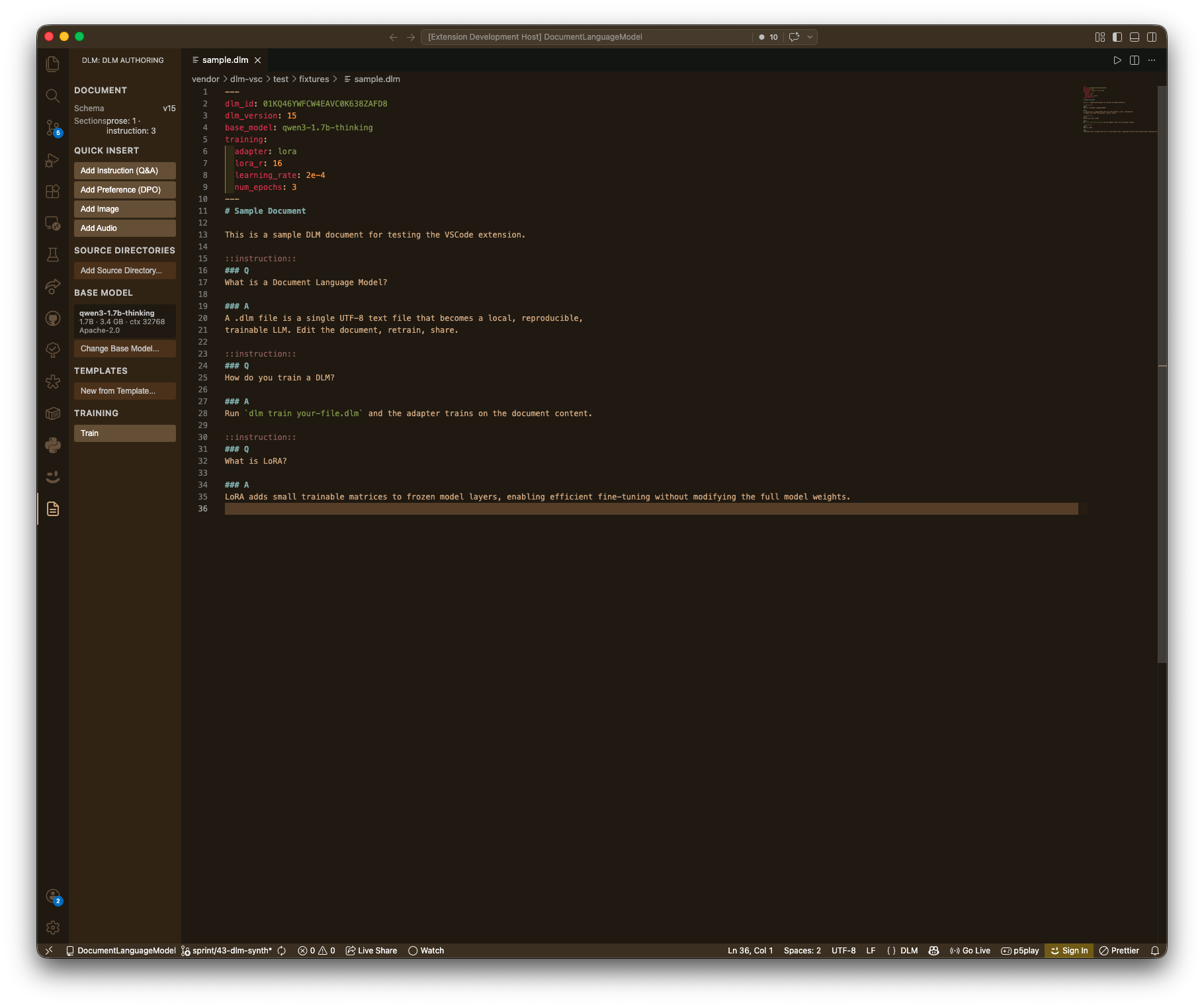
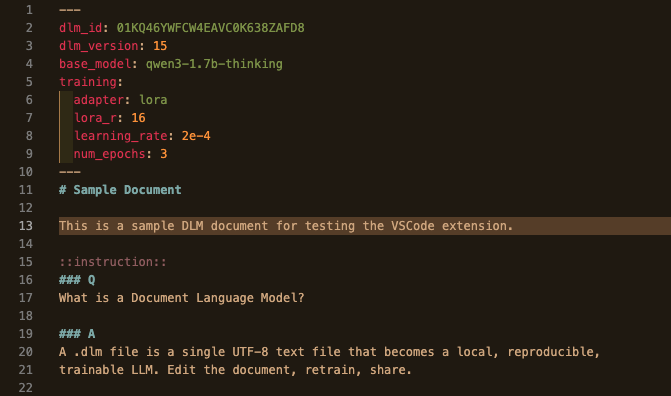
YAML frontmatter, markdown body, and section fences (::instruction::, ::preference::, ::image::, ::audio::) get distinct, theme-aware highlighting. Q/A headers inside instruction blocks are styled.
Smart completions
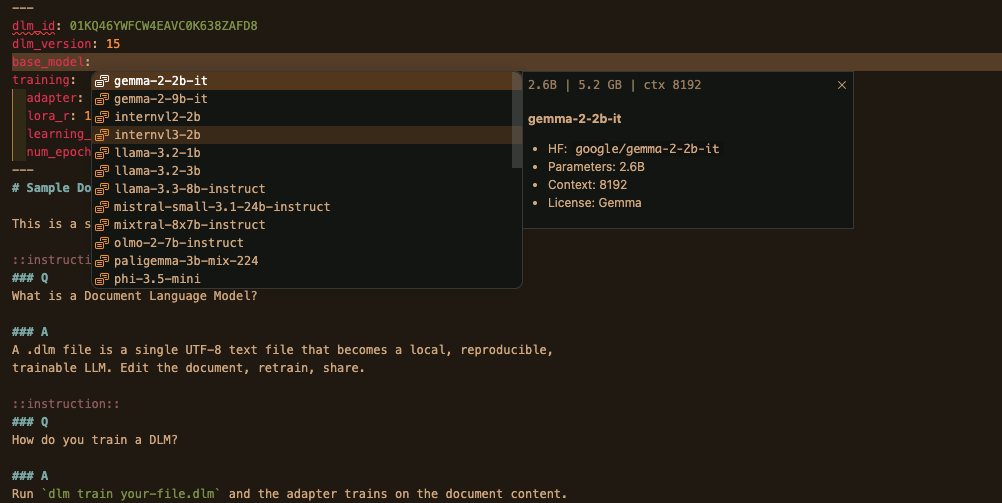
Autocomplete for the 26-entry base-model registry, adapter types, quantization levels, and section fences — all driven by the live schema.
Hover insight
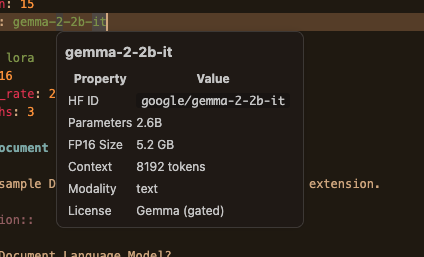
Hover any base-model key to see params, VRAM footprint, context length, modality, and license. Hover a section fence for the section ID and quick stats.
Live diagnostics
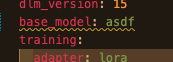
Schema errors, unknown base models, and Doctor warnings (VRAM headroom, unsafe combinations) surface inline as you type — no save required.
Side panel — frictionless authoring
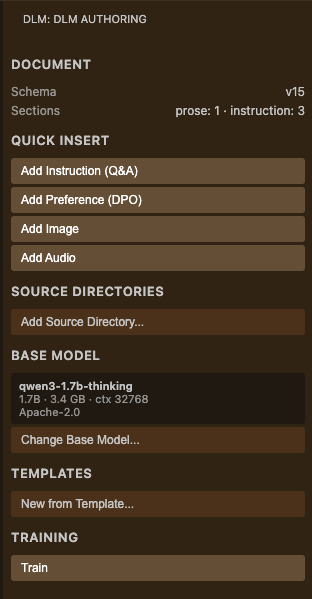
A dedicated DLM activity-bar view with everything you need to compose a .dlm:
- Quick Insert — Instruction, Preference, Image, and Audio buttons drop snippet templates with tab stops at the cursor
- Source Directory Manager — native folder picker; relative paths computed and inserted into frontmatter via the LSP
- Base Model Browser — searchable QuickPick over the full registry; click to set
base_model - Template Gallery — 8 bundled templates with one-click bootstrap
- Document Overview — section counts, store status, adapter version
- Training Controls — Run / Stop in an integrated terminal
Transparent store creation
Open a .dlm file. The content-addressed store at ~/.dlm/store/<dlm_id>/ is created on the spot — no manual dlm init needed.
Requirements
-
Python 3.11+ with the
document-language-modelpackage:pip install document-language-model -
dlm-lsplanguage server:pip install dlm-lsp -
(Optional) For training, choose a hardware-appropriate base. The Doctor panel will tell you what fits.
Quick start
- Install the extension.
- Create a new file with a
.dlmextension. The side panel becomes available immediately. - Click Add Instruction in the side panel and fill in the Q / A.
- Open the Base Model Browser and pick a small base (e.g.
qwen2.5-0.5b) for a fast first run. - Run
DLM: Train Current Documentfrom the command palette (⇧⌘P / Ctrl+Shift+P). - Run
DLM: Promptto chat with your trained adapter. - Run
DLM: Exportto package an Ollama-readyModelfile + GGUF.
Commands
| Command | What it does |
|---|---|
DLM: Train Current Document |
Fine-tune the LoRA adapter on the open .dlm |
DLM: Export |
Export base.gguf + adapter.gguf + Modelfile |
DLM: Synth Instructions |
Generate synthetic Q/A pairs from your sources |
DLM: Show Run History |
Browse training runs for the current document |
DLM: Open Store Directory |
Reveal ~/.dlm/store/<id> in the file manager |
DLM: Insert Instruction Section |
Drop an instruction block at the cursor |
DLM: Insert Preference Section |
Drop a preference block at the cursor |
Settings
| Setting | Default | Description |
|---|---|---|
dlm.command |
uv run dlm |
Command to invoke the dlm CLI (use dlm for system venv) |
dlm.home |
"" |
Override the ~/.dlm store root |
dlm.defaultBase |
"" |
Default base_model for new documents |
dlm.watchOnSave |
false |
Auto-retrain on save |
dlm.lspPath |
dlm-lsp |
Path to the dlm-lsp binary |
If dlm is on your PATH (e.g. installed system-wide), set dlm.command to dlm. The default uv run dlm works inside a uv-managed project.
Multi-editor support
The language server is editor-agnostic. Cookbook entries for Zed, Helix, and Neovim live in the main repository.
Links
License
MIT
View source
| 1 | # DLM — Document Language Model |
| 2 | |
| 3 | > Turn a text file into a fine-tuned LLM. Edit the document, retrain, share. |
| 4 | |
| 5 | A `.dlm` file is YAML frontmatter + markdown body with `::instruction::` and `::preference::` sections. Train a LoRA adapter on your document, prompt it, export to Ollama. This extension makes `.dlm` authoring a first-class editor experience. |
| 6 | |
| 7 |  |
| 8 | |
| 9 | ## Features |
| 10 | |
| 11 | ### Syntax-aware editing |
| 12 | |
| 13 | YAML frontmatter, markdown body, and section fences (`::instruction::`, `::preference::`, `::image::`, `::audio::`) get distinct, theme-aware highlighting. Q/A headers inside instruction blocks are styled. |
| 14 | |
| 15 |  |
| 16 | |
| 17 | ### Smart completions |
| 18 | |
| 19 | Autocomplete for the 26-entry base-model registry, adapter types, quantization levels, and section fences — all driven by the live schema. |
| 20 | |
| 21 |  |
| 22 | |
| 23 | ### Hover insight |
| 24 | |
| 25 | Hover any base-model key to see params, VRAM footprint, context length, modality, and license. Hover a section fence for the section ID and quick stats. |
| 26 | |
| 27 |  |
| 28 | |
| 29 | ### Live diagnostics |
| 30 | |
| 31 | Schema errors, unknown base models, and Doctor warnings (VRAM headroom, unsafe combinations) surface inline as you type — no save required. |
| 32 | |
| 33 |  |
| 34 | |
| 35 | ### Side panel — frictionless authoring |
| 36 | |
| 37 | A dedicated DLM activity-bar view with everything you need to compose a `.dlm`: |
| 38 | |
| 39 | - **Quick Insert** — Instruction, Preference, Image, and Audio buttons drop snippet templates with tab stops at the cursor |
| 40 | - **Source Directory Manager** — native folder picker; relative paths computed and inserted into frontmatter via the LSP |
| 41 | - **Base Model Browser** — searchable QuickPick over the full registry; click to set `base_model` |
| 42 | - **Template Gallery** — 8 bundled templates with one-click bootstrap |
| 43 | - **Document Overview** — section counts, store status, adapter version |
| 44 | - **Training Controls** — Run / Stop in an integrated terminal |
| 45 | |
| 46 |  |
| 47 | |
| 48 | ### Transparent store creation |
| 49 | |
| 50 | Open a `.dlm` file. The content-addressed store at `~/.dlm/store/<dlm_id>/` is created on the spot — no manual `dlm init` needed. |
| 51 | |
| 52 | ## Requirements |
| 53 | |
| 54 | 1. **Python 3.11+** with the `document-language-model` package: |
| 55 | |
| 56 | ```bash |
| 57 | pip install document-language-model |
| 58 | ``` |
| 59 | |
| 60 | 2. **`dlm-lsp` language server**: |
| 61 | |
| 62 | ```bash |
| 63 | pip install dlm-lsp |
| 64 | ``` |
| 65 | |
| 66 | 3. *(Optional)* For training, choose a hardware-appropriate base. The Doctor panel will tell you what fits. |
| 67 | |
| 68 | ## Quick start |
| 69 | |
| 70 | 1. Install the extension. |
| 71 | 2. Create a new file with a `.dlm` extension. The side panel becomes available immediately. |
| 72 | 3. Click **Add Instruction** in the side panel and fill in the Q / A. |
| 73 | 4. Open the **Base Model Browser** and pick a small base (e.g. `qwen2.5-0.5b`) for a fast first run. |
| 74 | 5. Run `DLM: Train Current Document` from the command palette (⇧⌘P / Ctrl+Shift+P). |
| 75 | 6. Run `DLM: Prompt` to chat with your trained adapter. |
| 76 | 7. Run `DLM: Export` to package an Ollama-ready `Modelfile + GGUF`. |
| 77 | |
| 78 | ## Commands |
| 79 | |
| 80 | | Command | What it does | |
| 81 | | --------------------------------- | ---------------------------------------------- | |
| 82 | | `DLM: Train Current Document` | Fine-tune the LoRA adapter on the open `.dlm` | |
| 83 | | `DLM: Export` | Export `base.gguf + adapter.gguf + Modelfile` | |
| 84 | | `DLM: Synth Instructions` | Generate synthetic Q/A pairs from your sources | |
| 85 | | `DLM: Show Run History` | Browse training runs for the current document | |
| 86 | | `DLM: Open Store Directory` | Reveal `~/.dlm/store/<id>` in the file manager | |
| 87 | | `DLM: Insert Instruction Section` | Drop an instruction block at the cursor | |
| 88 | | `DLM: Insert Preference Section` | Drop a preference block at the cursor | |
| 89 | |
| 90 | ## Settings |
| 91 | |
| 92 | | Setting | Default | Description | |
| 93 | | -------------------- | ------------- | ---------------------------------------------------------- | |
| 94 | | `dlm.command` | `uv run dlm` | Command to invoke the dlm CLI (use `dlm` for system venv) | |
| 95 | | `dlm.home` | `""` | Override the `~/.dlm` store root | |
| 96 | | `dlm.defaultBase` | `""` | Default `base_model` for new documents | |
| 97 | | `dlm.watchOnSave` | `false` | Auto-retrain on save | |
| 98 | | `dlm.lspPath` | `dlm-lsp` | Path to the `dlm-lsp` binary | |
| 99 | |
| 100 | If `dlm` is on your PATH (e.g. installed system-wide), set `dlm.command` to `dlm`. The default `uv run dlm` works inside a `uv`-managed project. |
| 101 | |
| 102 | ## Multi-editor support |
| 103 | |
| 104 | The language server is editor-agnostic. Cookbook entries for Zed, Helix, and Neovim live in the [main repository](https://github.com/tenseleyFlow/DocumentLanguageModel/tree/trunk/docs/cookbook). |
| 105 | |
| 106 | ## Links |
| 107 | |
| 108 | - [DLM main repository](https://github.com/tenseleyFlow/DocumentLanguageModel) |
| 109 | - [dlm-lsp language server](https://github.com/tenseleyFlow/dlm-lsp) |
| 110 | - [Issues](https://github.com/tenseleyFlow/dlm-vsc/issues) |
| 111 | |
| 112 | ## License |
| 113 | |
| 114 | MIT |